Economic Update | Apr 27, 2026
Hosted by Andrew Toccaceli, RICP®, MRFC® and Coley Neel, CFA® | W.A. Smith Financial Group


Get a clear look at what you’re paying and how much risk you’re taking. This complimentary review helps identify your portfolio’s costs, risk exposure, and opportunities to better align your investments with your goals — all with no obligation.
Get Started
The global oil market is experiencing one of its most significant price shocks in recent memory. A confluence of geopolitical conflict, supply chain disruptions, and constrained refinery infrastructure has sent crude oil prices surging toward, and at times beyond, $100 per barrel in early 2026, reverberating across financial markets, household budgets, and macroeconomic policy frameworks worldwide.
Investors must understand the mechanisms through which these price shocks transmit across the global and domestic economy, so that a framework can be developed to proactively adapt to the volatility in the markets on a domestic and global basis.
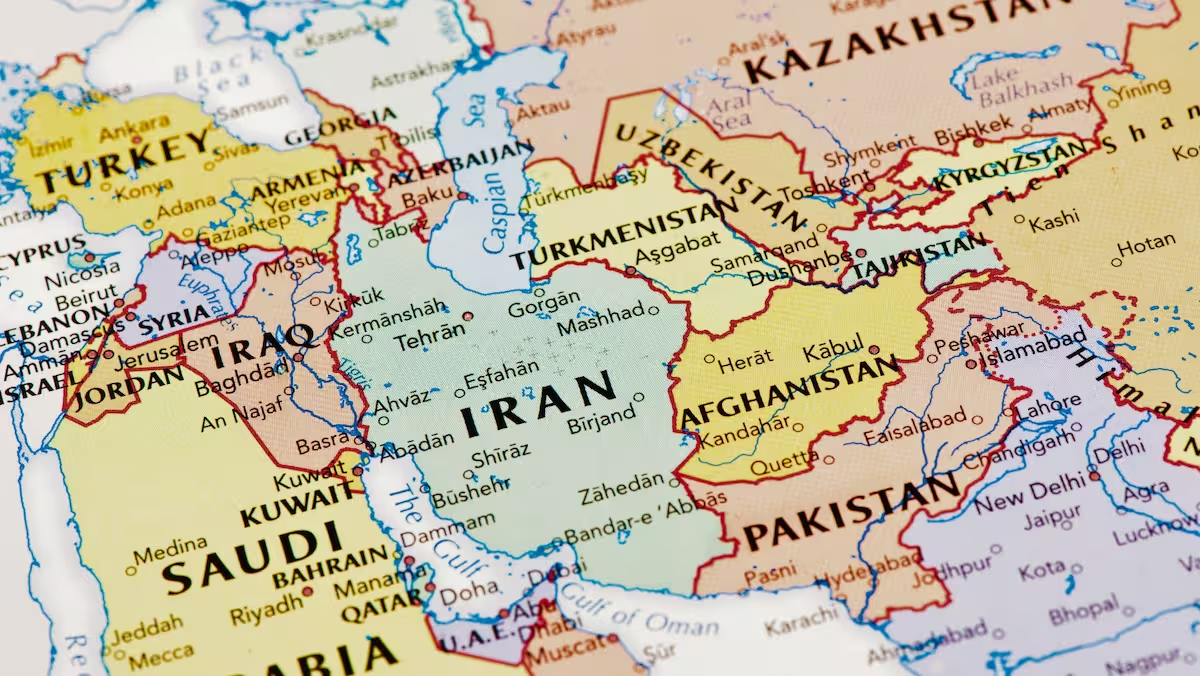
The current oil price disruption is principally supply-driven rather than demand-led. Escalating US-Iran conflict has disrupted oil exports from the Persian Gulf, a region that accounts for a critical share of global crude supply.
At the peak, crude briefly touched $120 per barrel before retreating, though prices remain sharply elevated relative to pre-conflict levels. Some analysts estimate that supply disruptions have shut in ~9 million barrels per day, with production shut-ins, damaged refinery infrastructure, and constrained storage all extending the timeline for any supply recovery.
A recent Bank of America forecast suggested a potential supply deficit of ~4 million barrels per day for Q2 2026, with the potential for a permanent structural shortfall of 3 to 5 million barrels per day persisting for years if infrastructure damage proves durable.
There are also estimates that a sustained spike to $100 per barrel could reduce global economic growth by approximately 0.4%. If the conflict remains unresolved, analysts warn that oil could surpass the peaks seen in 2022 following Russia's invasion of Ukraine, with multiple scenarios projecting prices of $150 per barrel.
This scenario would be particularly damaging because oil is deeply embedded in the cost structure of modern economies. The impacts are far- reaching as they influence not only fuel but the price of shipping, manufacturing inputs, food production, and consumer goods broadly.

The macroeconomic fallout of elevated oil prices is asymmetric across geographies. Europe and energy-importing emerging markets face the most acute risk, as rising energy costs inflate headline CPI, squeeze corporate margins, and compress consumer purchasing power simultaneously.
In the UK and Europe, for example, natural gas prices, which are closely correlated with oil in a supply shock environment, have nearly doubled since the onset of the Iran conflict. A potential result is that the euro area may face even greater inflationary pressure if natural gas prices remain elevated alongside crude oil.
For central banks, an energy-driven supply shock presents an impossible dilemma. The Federal Reserve's dual mandate, price stability and maximum employment, is directly pressured when oil prices spike: inflation rises even as growth risks increase.
We have started to see this in multiple economic data points, such as the Consumer Price Index (CPI), Producer Price Index (PPI), and the Personal Consumption Expenditure (PCE).
It is critical to note that the Headline figures for the above-mentioned data points are inclusive of energy and food components. If these components are removed, the Core data currently shows that inflationary pressures are relatively muted.
This is an important takeaway and shows the magnitude of the impact energy has on inflationary data.
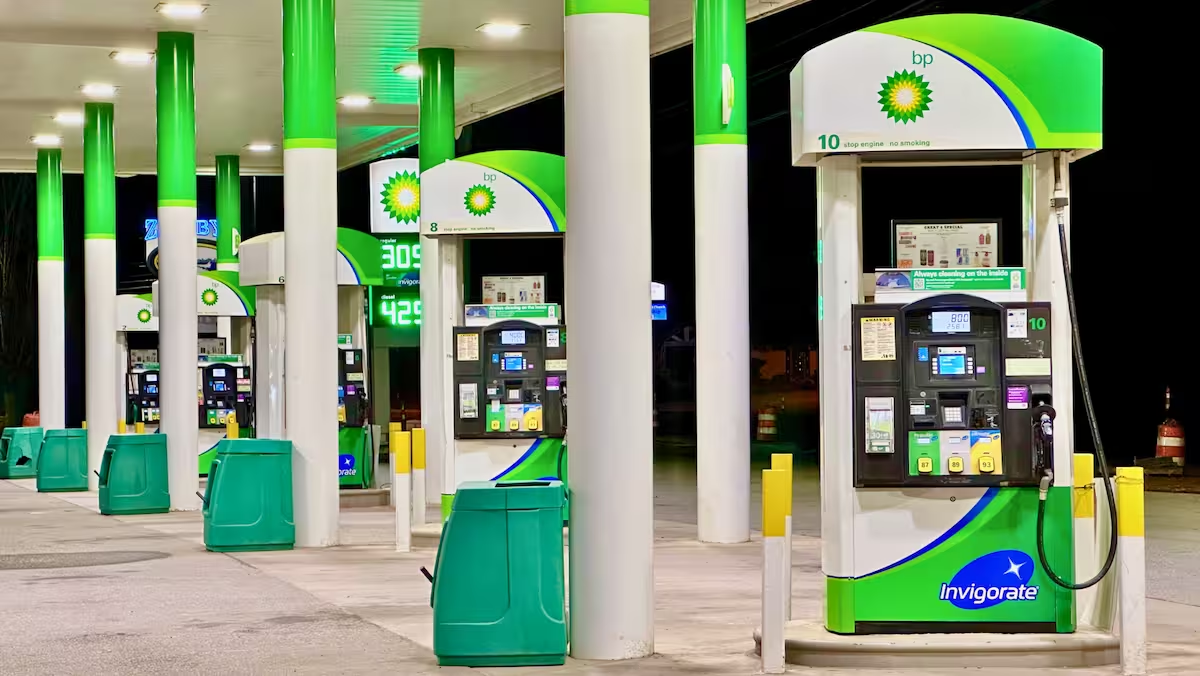
While the United States is a net exporter of petroleum products, it is not immune to global crude price shocks. Oil is traded as a global commodity, and domestic prices for crude, and more specifically fuel, are benchmarked against global markets, including Brent and West Texas Intermediate (WTI).
Every $10 per barrel increase in crude translates to a ~25-cent-per-gallon increase at the pump for US drivers (on average). This transmission mechanism explains why the national average for regular unleaded gasoline surpassed $4.00 per gallon in the first week of April 2026 for the first time since August 2022, reaching a peak of $4.16 before retreating slightly to $4.11 as of April 27.
Regional disparity is significant and explains why gasoline exceeds $5.90 per gallon in California, while central states remain in the $3.30–$3.80 range.
The composition of the retail gasoline price illuminates why crude oil prices carry such weight. The US Energy Information Administration (EIA) identifies the cost of crude oil as the single largest component of the retail price of gasoline, followed by refining costs, taxes, and distribution and marketing.
When crude spikes by 40–50%, the crude oil component of the pump price rises proportionally, overwhelming the relative stability of the other cost buckets.
This shows that the impact is felt across the vertical and is not easily reversed once volatility in the underlying’s price subsides.
Diesel fuel has historically traded at a premium to regular unleaded gasoline, and the current shock is amplifying that differential.
Three structural factors drive persistently higher diesel prices.
First, the refining process for ultra-low sulfur diesel (ULSD), the standard for on-highway diesel in the United States, requires additional processing steps beyond what is needed for gasoline, raising per-gallon production costs, particularly at refineries optimized for gasoline output.
Second, the federal excise tax on diesel is higher than on gasoline, ~24.4 cents per gallon versus 18.4 cents, a structural premium embedded in every gallon sold.
Third, diesel competes for refinery capacity with heating oil, particularly during winter months, further tightening the supply-demand balance.
In a supply shock environment, these structural pressures compound. When Middle Eastern refineries are damaged or taken offline, the global refined product market tightens for distillates, the category that includes diesel and jet fuel, even faster than it does for gasoline, because diesel refining requires more sophisticated capacity that takes longer to restart.
The trucking, logistics, and agricultural sectors, which are heavily diesel-dependent, endure much of this cost increase, and those costs cascade through the economy via higher freight rates and food prices, creating second-order inflationary effects that are difficult to contain.
This is one of the key components that we monitor when data such as CPI, PPI, and PCE are released monthly.

For investors, elevated oil prices create a dynamic, complex sectoral rotation. Energy companies, particularly US upstream producers with low break-even costs, benefit directly from higher crude realizations.
However, the broader market faces headwinds, as higher fuel and input costs compress margins across industrials, consumer discretionary, and transportation sectors.
Analysts have hypothesized that to induce a US recession, oil prices would need to remain at or above $150 per barrel for the remainder of the year, combined with significant financial condition tightening.
We see this as a low probability event, which would only likely occur if there were a resumption of attacks on Iran and potential boots on the ground. From all indications, this is not an outcome that any of the parties (the US, Israel, and Iran) want to entertain.
Short of that threshold, the resilience of US household balance sheets and labor markets provides a meaningful buffer.
Yes, we may continue to experience periods of increased volatility driven by crude oil pricing, but you need to know that we continue to monitor the situation and are taking proactive measures to mitigate risks while also investigating pockets of opportunities.

Our primary mission is to provide you and your family with Financial Peace of Mind, and we are confident that we have proven our adherence to that motto during the most recent market disruptions.
As stated earlier, we will continue to monitor the current economic environment and make well-informed decisions as it relates to the markets.
Our goal is for you to focus more on your life and worry less about your money. This goal is even more important as we enter the warmer days of Spring.
As always, we look forward to seeing you again soon!