Economic Update | Aug 27, 2026
Hosted by Andrew Toccaceli, RICP®, MRFC® and Coley Neel, CFA® | W.A. Smith Financial Group


Get a clear look at what you’re paying and how much risk you’re taking. This complimentary review helps identify your portfolio’s costs, risk exposure, and opportunities to better align your investments with your goals — all with no obligation.
Get Started
Interest rates have once again become an important part of the market conversation, but what we are seeing today is somewhat different from the environment of the past few years. For much of that period, the focus was almost entirely on the Federal Reserve and when it might begin lowering short-term interest rates.
More recently, however, we have seen longer-term Treasury yields move higher even as expectations for future Fed easing have increased. This has resulted in a steeper yield curve and, in our view, is sending an important message about the economy and financial markets.
The yield curve is simply a way of looking at the interest rates the US government pays to borrow money over different periods of time. Normally, longer-term rates are higher than shorter-term rates. For several years, that relationship was reversed, or "inverted," as the Federal Reserve aggressively raised short-term rates to fight inflation.
We are now moving back toward a more traditional curve, but not necessarily because interest rates are falling across the board.
Instead, much of the recent steepening has come from longer-term rates remaining elevated while shorter-term rates have moderated.
The bond market appears to be balancing several competing factors. Inflation has improved from its highs but remains a concern, economic growth has generally remained resilient, and the federal government continues to have significant borrowing needs.
Together, these factors have kept upward pressure on longer-term Treasury yields even as markets anticipate additional Fed easing.
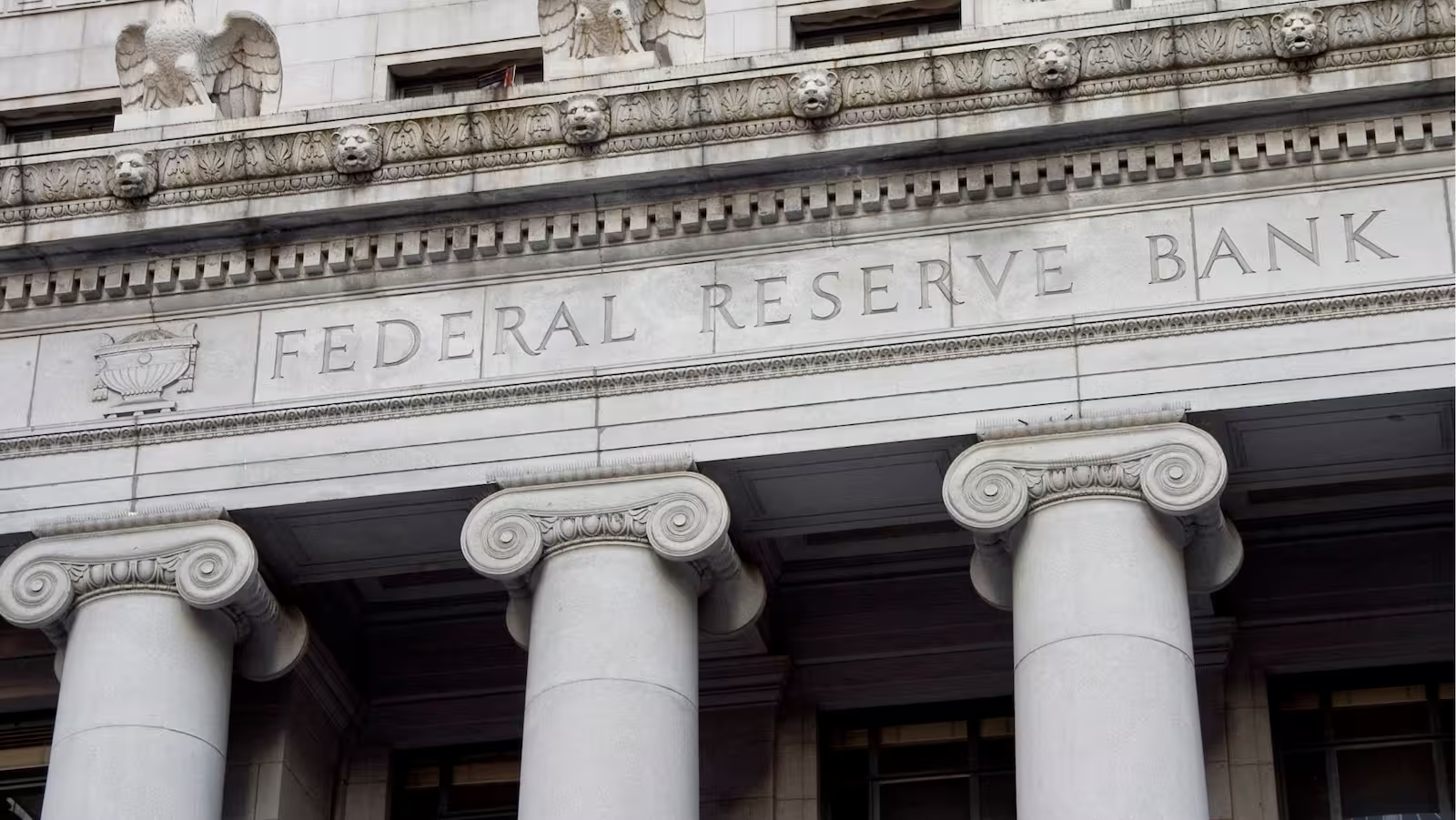
This is also where the recent actions from Treasury Secretary Scott Bessent have become important. The Treasury announced plans to increase its purchases, or buybacks, of longer-dated Treasury securities.
While the mechanics can become fairly technical, the basic idea is much simpler: Treasury is attempting to improve liquidity in the market and reduce some of the pressure that has developed at the longer end of the yield curve.
Initially, the announcement worked. Longer-term Treasury prices moved higher, and yields declined as the market reacted positively to the additional support.
Since then, however, some of that move has reversed. We believe that is an important part of the story.
Treasury can influence market conditions, but it cannot completely control longer-term interest rates. Ultimately, the market still must absorb a significant amount of government debt, and buyers will determine what level of interest rates they require to own that debt.

The Federal Reserve receives a great deal of attention when it changes interest rates, but the Fed does not directly control many of the borrowing costs we experience in everyday life.
Mortgage rates and many business borrowing costs are more closely connected to longer-term Treasury yields (typically the 10-year UST). Therefore, even if the Fed continues to lower short-term rates, we should not automatically assume that mortgage rates or other longer-term borrowing costs will decline at the same pace.
Higher long-term rates can create some challenges. Housing affordability can remain under pressure, businesses may be more selective when deciding whether to borrow and invest, and the federal government's interest expense increases as debt is refinanced at higher rates.
If longer-term yields remain elevated, these higher financing costs could eventually become more of a headwind for economic growth.

At the same time, we should not overlook the opportunities that have developed.
For much of the decade following the Financial Crisis, it was difficult to generate meaningful income from high-quality fixed-income investments. In many ways, that is no longer the case.
Today's yields allow us to generate more attractive levels of income from Treasuries and other high-quality bonds without necessarily having to take on excessive credit or duration risk.
We believe this continues to make fixed income an important part of portfolio construction.
As we move through the remainder of 2026, we will continue to watch both ends of the yield curve.
The Federal Reserve will have a greater influence over shorter-term rates, while inflation, economic growth, federal borrowing needs, and demand for Treasury securities are likely to have a greater influence on longer-term yields.
Bessent's recent actions may help improve market liquidity and reduce some pressure at the long end, but the market's reaction reminds us that there are larger forces at work.
For us, the takeaway is not that higher rates are necessarily good or bad. They create different challenges and different opportunities.
Our responsibility is to understand those changes and determine how they affect your financial plan rather than reacting to every move in interest rates or headline coming out of Washington.
Markets and interest rates will continue to change, but our approach does not. We will continue to evaluate the environment, make thoughtful adjustments when appropriate, and remain focused on what matters most: providing you and your family with Financial Peace of Mind.
We hope you are enjoying the remainder of the summer and look forward to seeing you again soon!